

How many Central Florida songbirds are there? Globally, there are 200 billion birds; the US homes 7 billion of them. Florida alone enjoys more than 500 different bird species. Central Florida’s environment provides abundant habitats for songbirds. Areas such as shady hammocks, marshes, pines, swamps, open forests, and more. This is why many see Florida as a prime birding locale.
Nearly 100 songbirds live in, pass through, or migrate to Central Florida each year. As the Native Songbird Care and Conservation points out, song birds add beauty and grace to our surroundings. From rare species and vagrants to regularly occurring songbirds, their presence is a source of delight for all birders.
In this writing, we’ll provide a broad overview of Central Florida songbirds. We’ll examine their distinctive traits and spotlight certain species.
What Makes Passerine Song Birds Unique
Central Florida songbirds, just like all song birds, belong to the order Passeri. Classified as Passeriformes (Oscines), they’re known as passerines. They’re more commonly known as perching birds. We find them everywhere, including one species in Antarctica, called the South Georgia pipit.

Songbirds have amazing singing capabilities because of their syrinx design
Most birds have 4 toes and walk on them instead of the bottoms of their feet. Perching birds have anisodactyl feet. This means that both feet have three toes on the front and one strong toe on the back. This is the most common foot type among birds.
However, there are two other distinct features that songbirds possess that most non-passerines lack. These would be the design of their flexor muscles and syrinx box.
Flexor Muscles for Gripping
Songbirds have an advanced syrinx that non-passerines lack
As the legs of a songbird bend, flexor tendons automatically lock. This creates a ratchet-like mechanism that makes the toes grip tight and clutch the branch. This keeps perching birds firmly attached to the branch without falling off, even while they sleep. When they straighten their legs out, the flexor tendon relaxes and releases the toes’ grip.
Special Syrinx Design
All birds, except for storks, New World vultures, and ostriches, have a syrinx. However, songbirds are distinguished by the complex muscles around their syrinx. This is a two-sided organ located at the bottom of the trachea.
Special cartilage and membrane compose a songbird’s syrinx. It has 6 pairs of individual muscles and is smaller than a raindrop. Songbirds control each side of their syrinx independently due to its design.
Songbirds can emit two distinct pitches from each side due to fine syrinx control. It also gives them the skill to trill and produce sweeping tones at the same time. Non-passerines have a primitive syrinx, lacking this fine control.
Facts About the Florida Official State Bird
On April 23rd, 1927, the northern mockingbird became the official state bird of Florida. Of all song birds, only the mockingbird is able to learn a whooping 200 songs. Mockingbirds perform medleys of mimicked birdsongs and other sounds. They often repeat these medleys several times. They can also mimic the sounds of non-avian species, such as frogs and dogs. They even imitate electronic noises like car alarms and mimic the songs of other mockingbirds that sing mimicked songs.
The northern mockingbird is a medium-sized bird. It has long legs with an overall gray-brown body and a lighter gray on its belly. It has white wingbars that lay across its darker gray feathers. It has a long tail that’s edged in white. Males and females are virtually indistinguishable from each other.
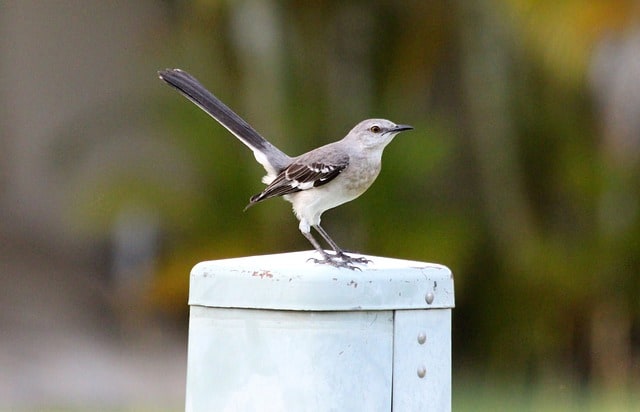
Northern mockingbirds used to be victims of the cagebird trade, being kept as pets
In the spring and early summer, females vigilantly watch for predators. Meanwhile, the males construct nests with twigs, lining them with moss, dead leaves, or grass. Every season, the female has between two to four broods. She lays three to five eggs, from turquoise to cream, spotted with brown. Hatchlings are recognizable by the white streaks on their backs and chests.
Male mockingbirds mimic sounds to deter rivals. These sounds create an illusion of a densely populated area. This discourages the rivals from nesting in the territory. Females can also sing. However, they don’t sing as often or as loud.
Females are highly territorial and will noisily protect their domain from other females. Male mockingbirds fiercely defend their territory and nesting area, driving intruders away. Other birds, animals, and occasionally people have felt their wrath. This year-round songbird is typically a monogamous bird. However, a female could change mates if the current mate’s nest defense is poor.
New Florida State Bird Contenders
The northern mockingbird may face unfortunate news in the near future. Growing sentiment seeks to replace the century-old state bird. There have been talks about new contenders to better represent the image of Florida. This includes birds like the flamingo and other unique birds. Some would prefer a bird that’s not adopted as a state bird elsewhere.
Suggestions include the white ibis, swallow-tail kite, and wood stork as alternatives. People are also considering the roseate spoonbill and osprey. Even the threatened Florida scrub-jay, an indigenous bird species, has made this list.
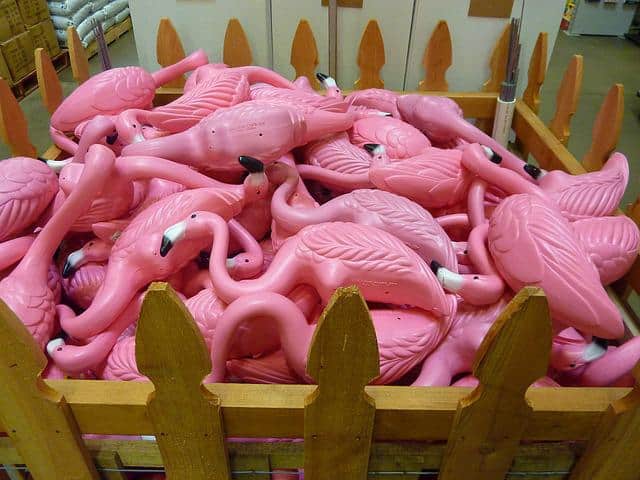
Flamingos are synonymous with Florida, and there’s enough evidence to hint that they may be native
Some state senators, lobbyists, and wildlife officials have expressed their preferences. The Sunshine State has yet to determine a new official state bird. It seems evident the northern mockingbird’s reign as Florida’s state bird is coming to a close.
Popular Central Florida Songbirds
Many enjoy the pastime of watching their favorite songbirds in their backyard. It’s considered both a peaceful pastime and an enjoyable activity. Goldfinches, blue jays, and cardinals are all common backyard favorites. Just about anybody can enjoy these songbirds anywhere in Florida.
Between their masterful melodies and beautiful plumage, it’s easy to see how these creatures can bring peace and beauty to the life of bird watchers and birders alike.
American Goldfinch
American goldfinches are also called wild canaries. However, they are not a true wild canary. Many migrate to Florida in mid to late autumn. They appear more drab during fall and spring than they do in the summer months. Male and female feathers are drab brown, with dull black wings and two off-white wing bars. Males have black on top of their heads and some yellow on the throat.
Juveniles and females look similar. By mid-February, the adult male is starting to display more yellow. By the time he migrates back to his breeding grounds, he will be more vibrant yellow.
American goldfinches are normally monogamous. They live in open meadows, orchards, gardens, fields, and floodplains. During the summer months, female goldfinches lay between two and seven eggs. On the large end, these eggs have faint brown spots and are pale bluish-white.
During the winter, American goldfinches are often found in groups. Listen for their unique call, which sounds like po-ta-to-chip. Females can also sing, however, the male’s song is more varied.
Goldfinches, like many songbirds, eat seeds from backyard bird feeders. Feeders filled with sunflower seeds, Nyjer thistle seeds, and chips are favorites. Primarily plant and seed-eaters, they rarely consume insects unless feeding nestlings.
American goldfinches eat a variety of seed, such as:
- Tree seeds
- Flower seeds
- Tree seeds
- Grass seeds
- Weed seeds
In February, when new twigs and buds are sprouting on hardwood trees, their diets change. They leave backyards in search of this new springtime growth. It will appear as though they have all left to head back north and northwestern parts of the country. However, this is a false migration. Once these soft branches become too tough and fibrous, they return to the backyard feeders. This is when they prefer more thistle seeds in their diet. This provides them with extra energy for their true migration back to their breeding grounds.
Northern Blue Jay
Northern blue jays are not true migratory songbirds. However, juveniles and adults often can and do migrate. Most of Florida’s blue jays live in the state year-round. But some migrate to and from the state. Some may even migrate one year, stay the next, and migrate again the following year. Perhaps the need for food and shelter from harsh winters prompts these migrations.
Blue jays sport royal blue plumage with whitish-gray underbellies. Their white faces bear a black outline that extends beneath the crest. It encircles the beak and runs along both sides of the throat. Black horizontal lines run through their eyes. The outline ends just above their breast. Their long tails display a distinctive checkered-looking pattern of black, white, and blue. Male and female adults look similar. Immature blue jays have a similar appearance to adults. They are smaller and scruffy.
Blue jays are often found in forests, parks, woodlots, cities, and towns. Females and males help with the nest building and raising their young. A bonded pair may stick together through several nesting seasons. They build their nest 10-30 ft. above the ground. They prefer treetops in woodlands and parks, of both deciduous and coniferous trees. Females lay between two to seven blue-green eggs with brown spots. Blue jays often have two clutches a year.
Several types of prey, insects, fruit, and seed make up the blue jay’s diet, including:
- Frogs
- Mice
- Bird eggs
- Beetles
- Grasshoppers
- Caterpillars
- Cherries
- Elderberries
- Huckleberries
- Blackberries
Some consider the blue jays to be bully birds. They can be raucous and dominate backyard feeders. Smaller songbirds often experience bullying from them over food resources.
But others feel that the blue jay has been labeled erroneously. They believe blue jays are merely territorial. Their aggressive behavior comes naturally. It’s an inherent urge to protect their offspring, nest, food, and domain.
Northern Cardinal
You can find northern cardinals dwelling amidst dense bushes, shrubs, and vines. They thrive in cities, suburbs, homes, and parks.
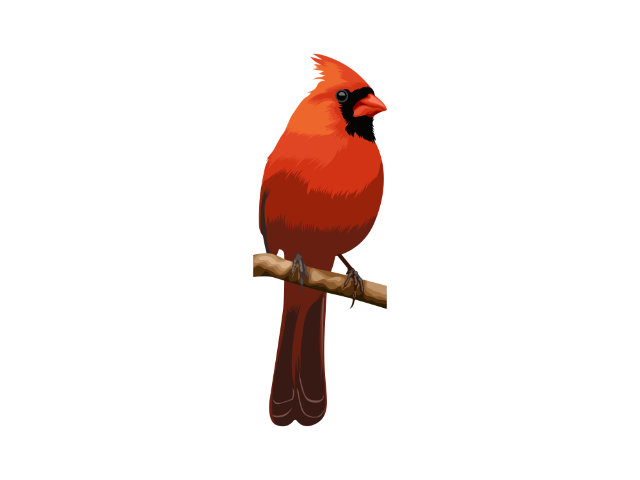
The adult male is vibrant red. He has a black mask and throat and a bright red crest. In contrast, the female cardinal is tawny brown. Orange-red colors tinge her wings, tail, head, and crest. The male and female have an orange, short, cone-shaped beak.
In color, juvenile cardinals look similar to adult females. In about a year, juvenile males will molt into a vibrant red color.
Their carotenoid-rich diet gives the males their stunning red plumage. The more carotenoids they eat, the brighter their feathers are. Females might favor males with a more vivid red. As well, females will have hints of red throughout their feathers.
Northern cardinals eat the following foods:
- Several fruits, including apples and cherries
- Many berries like serviceberries, mulberries, raspberries, and strawberries
- Multiple types of seeds
- Bugs and insects like spiders, beetles worms, butterflies, and moth
During the breeding season, a male cardinal usually has one mate. Often the male and female mate for life.
Females have a clutch of four white eggs speckled with brown. Each year, they have about two to three broods. Fewer than half of these will survive due to predators and bad weather.
Migratory Song Birds of Central Florida
Many Central Florida songbirds return every winter and leave in the spring. Migratory songbirds overwinter here from November through February, like the ovenbird and the black and white warbler. Some arrive as early as August. Songbirds such as the American Goldfinch and the Baltimore oriole are early arrivals. As the weather starts getting cooler in the north and the west, many songbirds leave their breeding grounds. For a few months, they call the warmer climate of Central Florida home.
Some Florida song birds stay year-round like the Carolina chickadee and Carolina wren. Other songbirds will layover as they’re passing through Central Florida on their way to somewhere more tropical. Song birds like the gray-cheeked thrush are only here briefly.
Adding suet cages and a variety of birdfeeders to your backyard may entice songbirds
Migratory songbirds are thought to travel in search of food. They also seek shelter from intolerable weather conditions. North American songbird fall migration often follows the pattern of hyperphagia (the instinct to eat extra food to gain more energy). For songbirds, this means storing energy for a long migration. This begins after the last of the hatchlings leave their nest. It often takes several weeks for songbirds to get to where they’ll overwinter.
Over 300 songbirds embark on their migration in late summer and early fall. With the right strategies, some may even stop by.
Trying to attract birds to your backyard?
Now’s the time to hang up suet cages and multiple bird feeders in your backyard. Add a variety of bird seeds, nuts, and berries to each feeder. This helps provide these weary migrant travelers with much-needed nutrients. This way, they can rebuild their depleted energy stores again.
Want to know what birdfeeders are best for the kind of birds you’re trying to attract?
Helpful Florida Songbird Identification
Some Central Florida songbirds are year-round residents, like the tufted titmouse and house sparrow. Others are seasonal, visiting during specific times of the year. American robins and eastern phoebes are songbirds that are seasonal winter visitors to Florida.
The following lists the many songbirds that you might see in Florida:
Cardinals | |
 Image by GeorgeB2/ Pixabay | |
Thrushes | |
 Image by GeorgiaLens/Pixabay | |
Wrens | |
 Image by maiakphotography/iStock | |
Vireos | |
 Image by Carol Hamilton/iStock | |
New World Warblers | |
 Image by theSOARnet/Pixabay | |
Crows and Jays | |
 Image by JackBulmer/Pixabay | |
Tyrant Flycatchers | |
 Image by leoleobobeo/Pixabay | |
Swallows | |
 Image by paullbushart/Pixabay | |
Mockingbirds and Thrashers | |
 Image by Bernell/Pixabay | |
New World Sparrows | |
 Image by 366photos/Pixabay | |
Troupials | |
 Image by MillionPM/Pixabay | |
Finches | |
 Image by chas53/iStock | |

Not all of these songbirds will come to your backyard. Many have specific habitats they live in, such as the cliff swallow. Others are scarce and rarely seen, like the Bachman’s sparrow.
If you want to see these kinds of songbirds, then you’ll need to bring the right birdwatching gear to the right places. *Link birdwatching essential gear article once it’s been split
Final Thoughts
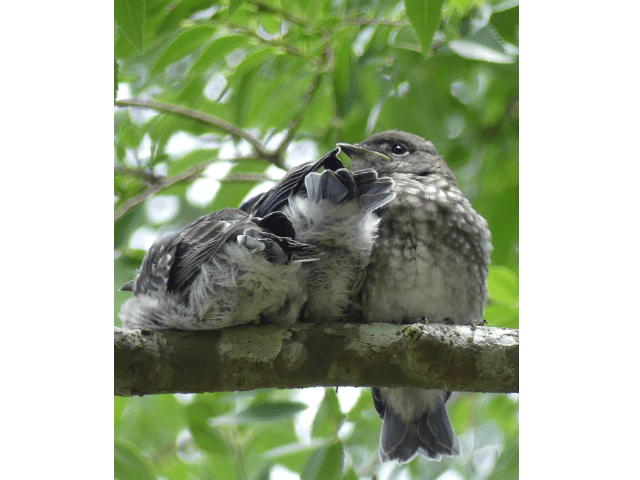
Bluebirds can have as many as 7 clutches a breeding season, which can contain as many as 5 eggs each
Having lived in the Central Florida region for nearly two decades, we’ve enjoyed many song bird species right in our own backyard. Some of our favorite songbirds are common backyard visitors. This includes bluebirds, chickadees, tufted titmice, and cardinals. We’ve also also had occasional visitors that visit by chance. This could be because of severe weather or during a migration pit-stop. Some have stayed for a few days. Others have stayed for a few weeks. We’ve been lucky to observe:
- Yellow-throated warblers
- Blackpoll warblers
- Baltimore orioles
- Summer and scarlet tanagers
- Red-winged blackbirds
- Painted buntings
From birdwatching hotspots or right from your kitchen window, Central Florida songbirds can be seen almost anywhere. What’s your favorite songbird? Be sure to let us know.