

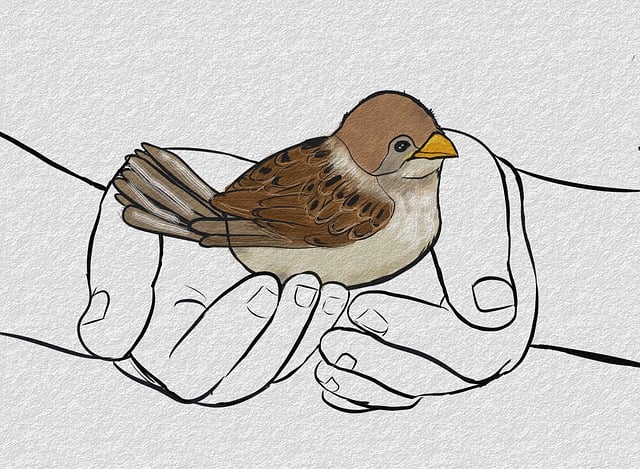
Florida song birds of all kinds call Florida home. They add beauty and balance to the ecosystem. However, these feathered residents face numerous threats. Protecting these songbirds is a critical task. Public awareness and respect for wildlife laws are crucial.
Florida’s diverse songbird population faces several threats. They require constant, concerted conservation efforts. The Audubon Society highlights the urgent need to be proactive. They warn that habitat loss and illegal trafficking are severe. It’s crucial to be involved in the protection of these vulnerable songbirds.
Read on to learn about the laws that protect our songbirds. Learn about multiple vulnerable species and the many threats they face.
The Migratory Bird Treaty Act
Do you collect Florida song bird feathers that you find on the ground? There’s no harm in keeping them, right? Don’t be fooled; if the feather came from a protected songbird, it’s illegal. How can that be, you ask? They’re simply shed or molted feathers that I found on the ground.
Law enforcement can’t tell whether or not a feather was molted, shed, or plucked. For all they know, you could’ve plucked that feather from the bird itself. Because of this, the law was written broadly. Any feather from a native migratory bird found in your possession is illegal. Breaking this law can result in hefty fines and possible jail time.
How did this all come about? In 1897, two prominent women aimed to put a stop to poaching birds for their feathers. Their names were Harriet Hemenway and Minna Hall. These prominent women promoted an end to the feather trade. They worked with New England ornithologists, scientists, and other prominent men in the Boston area.

The Migratory Bird Treaty Act makes it illegal for you to posses songbird feathers
Their combined efforts helped push the Congressional passage of the Weeks-McLean law. This wildlife protection treaty is one of the oldest on the books, being passed in 1913. It curtailed the use of feathers being used in women’s hats. This was a popular trend during that era.
However, the law was later deemed unconstitutional. It was replaced by the Migratory Bird Treaty Act (MBTA). This act was signed in 1916 by Canada, then followed by the United States in 1918. Between 1936 and 1976, agreement treaties were added with Mexico, Japan, and Russia.
More than a thousand birds are protected under this treaty in the United States. Only two song birds aren’t protected—European starlings and house sparrows.
Illegal Bird Trafficking in Florida
Every year in Florida, thousands of songbirds are illegally trafficked.
Offenders can face hefty fines and possible jail time if they’re caught:
- Trapping songbirds
- Killing songbirds
- In possession of songbirds
Smuggling or selling song birds is a felony. This can lead to extensive jail time.
Trafficked songbirds are often found injured or dead. Often, this is due to negligence or purposeful abuse by their captors. Other times it’s because they’re trapped in the nets they were captured in. This leaves them vulnerable to harsh conditions or animal predators.
Commonly trafficked songbirds and their conservation status:
Commonly Trafficked Species | Conservation Status |
Painted Bunting | Near Threatened |
Yellow-Throated Warbler | Near Threatened |
Prothonotary Warbler | Declining |
Hooded Warbler | Vulnerable |
Bobolink | Declining |
Wood Thrush | Near Threatened |
Illegal poachers and trappers target these songbirds for their feathers or unique songs. Males are especially vulnerable since they typically display more vivid plumage compared to females.
Certain songbirds are in high demand in some parts of Florida. Especially South Florida. It’s a thriving market where buyers are willing to pay. As well, there are songbird singing competitions. Illegally possessed songbirds compete for best singing. The winning songbird can make its captor profit thousands of dollars. These large, pre-arranged events are kept quiet.
In 2019, Florida’s Fish and Wildlife Conservation Commission (FWC) had a new rule. This rule, along with the MBTA, allows the FWC to save more songbirds. They can remove captive song birds and seize illegal traps more easily now.
Painted Bunting: Declining
Adult male painted buntings display an array of colors. You can’t miss them. Males have a vibrant indigo-blue head, red underbelly, and a green back. Females and juveniles are strikingly different looking from adult males. They’re vivid olive green/greenish-yellow in color. These song birds’ flashy palette has earned them the title “nonpareil”. This French word means “unrivaled beauty”.
Sometimes painted buntings are monogamous. Other times, males will have multiple mates. Females lay up to four grayish to bluish-white eggs. They’re dotted with gray or brown spots.
Painted buntings prefer to live, hide, and build their nest in dense thickets and shrubs. They have a seasonal-based diet. Most of the year, they eat seeds. They feed their babies insects and snails during the breeding season.

In some parts of Florida, painted buntings are common bird feeder visitors
These unique songbirds have two distinct geographic breeding populations. One is the western population, the other is the eastern population. In late August, southeastern painted buntings leave their breeding grounds. They head for Florida or further south to the Caribbean. They often migrate at night, using the stars to navigate their way.
The oldest painted bunting lived for 12 years. But most live much shorter lives. Their population has been decreasing. This decrease is partly because they are trafficked and sold as exotic pets.
Cowbirds are another reason for dwindling numbers. These parasitic songbirds lay eggs in the bunting’s nest. The larger baby cowbird often out-competes the nestlings for attention, food, and space. In Florida, it’s common to see adult painted buntings feeding a cowbird fledgling as if it was their own.
This beautfiul songbird can also be enjoyed in Central Florida. Want to know more about other Central Florida songbirds?
Loggerhead Shrike: Declining
Loggerhead shrikes are about the size of a cardinal. Males and females are identical with the male being slightly larger. They have a gray compact body with a white throat and belly and a short neck. They don thick, black masks and have hooked black beaks. Their tail is black, edged with white. They have black wings with a white flash.
Juvenile loggerhead shrikes are light brown to dull gray. They have light wing buffs and barring on their underside.
Females lay 2–9 eggs colored light gray or buff with brown spots in cup-shaped nests. They raise 1–2 broods per season. These songbirds eat a diet of insects, small mammals like rodents and bats, amphibians, and lizards. Loggerhead shrikes are also known to eat small adult songbirds when given the chance.
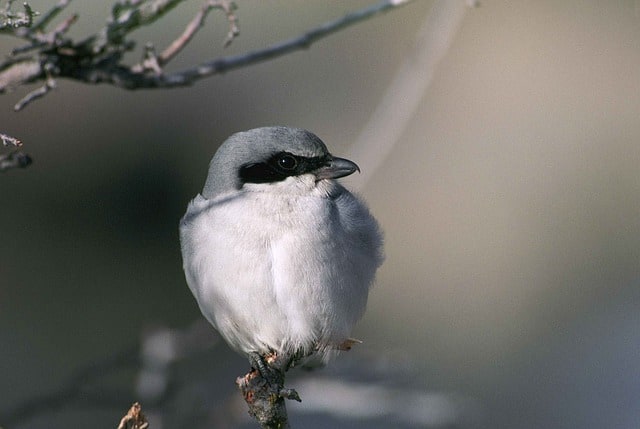
Loggerhead shrikes are the only truly carnivorous songbird
These carnivorous Central Florida songbirds resemble birds of prey. True birds of prey use strong talons to grasp their prey, breaking backs and crushing skulls. The shrike doesn’t have strong talons or that kind of strength. They only have the legs and feet of passerines. What they lack in strength in their feet, they make up for with their beak and strong neck. The bird’s powerful beak breaks its prey’s neck. This action immobilizes the prey by causing paralysis.
Shrikes impale their prey on something sharp, such as a cactus, thorns, or a barbed wire fence. Often, the prey is still alive when it’s impaled. Over the next few days, the shrike returns several times to pick at its meal. Males often display impaled prey to entice female mates.
The shrike population has been decreasing. Since the mid-1960s, their numbers have declined by nearly 80%. In part, this is because they primarily eat insects during the breeding season. Increased use of pesticides has reduced insect numbers. This has left fewer available insects for them to eat and feed their nestlings. Collisions and habitat loss may also play a part in the dwindling numbers of these unique songbirds.
Bachman’s Sparrow: Near Threatened
Bachman’s sparrows are known for their shy and elusive behavior. The best chance to see them is during their breeding season. When they feel threatened, they hide in burrows. These burrows are dug out by armadillos and gopher tortoises.
They have brown coloration, with a rusty crown and gray face. They have a thin, brown eye stripe. Their underparts are pale gray, and their backs and wings are streaked brown and gray. Males are slightly larger than females. Overall, they are identical in appearance. Juveniles have dull brown, camouflaged plumage. This helps protect them from predators.
Most of the year, their diet consists of seeds and grains. During the breeding season, they primarily eat insects and other bugs. In Florida, Bachman’s sparrows typically breed between April to early August. These songbirds are generally monogamous. The females make domed grass nests on the ground in Florida prairies. Each year females have one to two broods with a clutch of three to five eggs. Their white to pale blue eggs are speckled with reddish brown.
These sparrows are endemic to the southeastern states of the US. They are the most abundant in the Sunshine State. That being said, the Bachman’s sparrow is still an uncommon sight to see. It’s not just because they’re skittish. It’s also because they’re becoming more scarce.
Bachman’s sparrow numbers declined by 3% every year between 1966–2001
The Bachman’s sparrow prefers to live in open longleaf pine forests and oak openings. But these habitats are disappearing. In the past, longleaf pine was harvested and cleared out to near extinction. It hasn’t recovered since. Oak openings rely heavily on natural fires. These fires clear out overgrowth for a maintained, balanced environment. For the Bachman’s sparrow, this meant being able to forage off the ground, because they rarely eat elsewhere. However, these much-needed fires have been suppressed. This is to contain the spread of wildfire to urban developments.
The longleaf pine is endangered and oak openings are among the rarest habitats on earth. Now, the Bachman’s sparrows have no choice but to look for another habitat. These unsuitable habitats include old pastures and clearcuts.
Natural threats persist, too. Severe weather events and predation can impact their populations. With less habitat available, these threats can have more significant impacts. Between 1966 and 2001, Bachman’s sparrows declined by 3% every year. They have been declared near threatened. In 2020, they were added to IUCN’s threatened species red list.
Florida Scrub-Jay: Threatened
Florida scrub-jays are the only Florida song birds that are federally threatened. As well, they’re the only bird species endemic to Florida. We’re fortunate to observe these songbirds in Flagler, Marion, and Citrus counties. The largest populations of scrub-jays are in Ocala National Forest.
Adults are medium-sized with long blue tails and blue bodies. They have a blue nape and head, with a whitish-gray forehead. Their underbelly is white and their back is a light gray. Females and males are nearly identical in looks. Males are slightly larger.
Immature Florida scrub-jays are mostly gray with a dull brown underbelly. They lack much of the blue coloring seen in adults. By late summer and early fall, juveniles look like the adults.
When the fledglings mature, they don’t leave the area right away. Adult offspring become “helpers”. They help care for the new broods. As well, they defend the territory, nestlings, and their parents. Multiple adults often live in a single-family unit.
Due to urbanization and fire suppression, the Florida scrub-jay population has decreased
Florida scrub-jays prefer sandy soil. They live in low-growing oak scrub and sand pine thickets. Breeding in early spring, they lay up to five eggs. On average, they only have one clutch yearly. Occasionally, they’ll attempt a second brood if the first brood fails.
They have many predators, like ravens, raptors, snakes, domestic cats, and bobcats. They also fall victim to car collisions. On average, their life span is less than five years.
Within the last century, 90% of their population has decreased. This is due to urbanization and fire suppression. Currently, there are only an estimated 9,300–7,700 of these songbirds left in the state.
Much of their habitat has either been destroyed or lacks maintenance. Natural wildfires used to clear out dense, excessive vegetation. This would allow new growth of plants, shrubs, seeds, and fruit. It prevented the overgrowth of old scrub, which isn’t a viable habitat. However, over time, people started to suppress natural wildfires.
Much of the oak scrub has been lost or overgrown for other reasons, too. A large cause is the expansion of rural and urban developments. The FWC now prescribes regular scrub burn-offs. This improves and maintains the habitat of much of the wildlife. That includes the endemic Florida scrub-jay.
Florida Grasshopper Sparrow: Endangered
Florida grasshopper sparrows are one of the most endangered bird species in the United States. They live in prairie lands. This habitat includes grasses, sedges, saw palmetto, cabbage palm, and slash pines.
Like Florida scrub-jays, these sparrows need prescribed burn-offs of their habitat. As well, they are also endemic to Florida as a sub-species. Their name comes from their song, which resembles a grasshopper’s chirp.
Grasshopper sparrows have a cream-colored underside. On the back, tail, and wings they have a mottled pattern. This pattern is black, brown, and white. They have white circles around their eyes. Sometimes they have an orange dot between their eyes and beak.
Predators may be partially to blame for their decline. Common predators include fire ants, hawks, snakes, and loggerhead shrikes. Genetic issues and parasites are also responsible. On average, Florida grasshopper sparrows live between two to five years.
These sparrows have about 5 broods per year, laying up to 5 eggs in each clutch. They lay eggs in clumps of grass or under palmettos in prairie grasslands.
Birders can see grasshopper sparrows at Kissimmee Prairie Preserve State Park.
Are you new to birdwatching? Read our guide to choosing binoculars to get you started. *Link to our choosing binoculars article when it gets split
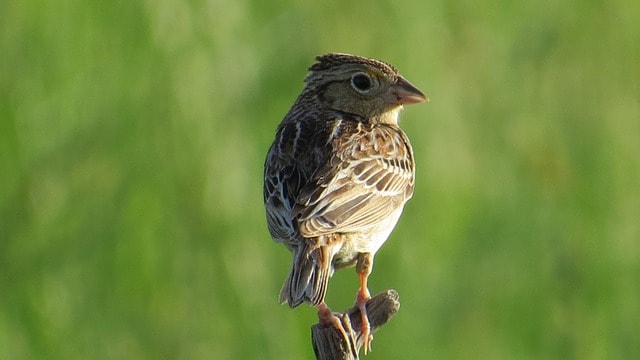
According to Florida State Parks, the Florida grashopper sparrow is the rarest bird in North America
In 2016, rain flooded the Florida grasshopper sparrow’s habitat. This destroyed all known nests in a single day. Fortunately, conservationists were able to rescue most of the sparrows. They also successfully preserved some of the eggs.
However, once rescued, sparrows in the state’s captive breeding program became ill. They suffered from internal coccidiosis, caused by coccidia parasites. This parasite kills these Florida song birds by attacking vital organs. Notably the heart, spleen, and liver. As well, they had eastern equine encephalitis and coelomic filariasis. These were common parasites and diseases among these songbirds.
In 2017, the grasshopper sparrow was thought to become completely extinct by 2019. In 2018, there were fewer than 80 of them in the wild, with only 15 breeding pairs.
In May 2019, the captive Florida grasshopper sparrows were released back into the wild. The fear of extinction was bigger than the fear of spreading the parasite.
In 2020, additional sparrows were released throughout the year. About 30% of the juveniles survived. It didn’t appear that the parasite was spreading. At the end of their breeding season, 112 of these sparrows were counted. There’s still a long way to go. However, this has helped these sparrows edge away from the brink of extinction. This reintroduction effort resulted in successful breeding. As of this writing, there are now more than 120 wild grasshopper sparrows.
Combating Climate Change: The Decline of North American Songbirds
Biologists have noted North American songbirds are declining in number. Almost three billion songbirds have been lost in the last 50 years. Birdwatching helps people become aware of the importance of safeguarding our environment.
Slowing down climate change ensure that songbirds have native plants. These plants provide food and safe high-quality nesting habitats. This allows everyone to enjoy songbirds for years to come.
Many efforts have been made by conservationists and people alike. Thanks to this, there are several sanctuaries for vulnerable songbird species. Florida scrub-jays and Florida grasshopper sparrows wouldn’t survive without these refuges.
The Bottom Line for Protecting Florida Song Birds

Bobolinks suffer trafficking from loss of habitat, which includes fields, hay meadows, and grasslands
This was just a glimpse at some of the most vulnerable Florida song birds. Many more face these kinds of challenges every day.
It’s critical to preserve the songbirds of Florida. It’s a duty we all share. It requires not just a single action, but collective efforts from many. Communities, conservationists, and legislators alike. The survival and flourishing of these songbirds are a reflection of us. It reflects our commitment to maintaining Florida’s rich biodiversity. When we save songbirds, we save one of the natural beauties of Florida.
Feature image by Tilixia/ Pixabay