

Cicada killer wasps are big and scary. Imagine, one day you are confronted by what appears to be a very large, angry-acting, and fearsome-looking hornet and you’re convinced that you’ve just seen the invasive species—the giant murder hornet that has been all over the news. Upon closer inspection, you also notice several more and are convinced more than ever that you have Asian giant hornets invading your Central Florida backyard.
There isn’t evidence of murder hornets present anywhere in Florida at this time, according to Florida’s Department of Agriculture and Consumer Services. One of the largest wasps in the eastern United States is the cicada killer wasp. Cicada killer wasps are many times confused for murder hornets.
Stinging insects strike fear into many people. Add the words giant or murder to the description and visions of marauding hornets on steroids is enough to make some people’s knees buckle. With all the media buzz about Asian giant hornet sightings in the US, a native insect that has mostly gone ignored by many people is starting to get their attention.
It’s not surprising that those unfamiliar with Florida’s eastern cicada killer wasp (Sphecius speciosus) could mistake them for Asian giant hornets. From a brief glance, they both seem similar. Aside from how large they are, Central Florida’s eastern cicada killer wasps have other attributes that might fool someone into thinking that they were Asian giant hornets. Some similar attributes are amber-tinted wings, pinched waists, and stripes on their abdomens.
There are currently 22 known species of cicada killer wasps throughout the world. Of these species, the eastern cicada killer wasp calls Florida home. They’re also known by a few other names such as cicada hawks, ground digger wasps, and sand hornets.
Let’s take a closer look at Central Florida’s eastern cicada killer wasp.
*Switch “Cicada Killer Size” with “Where do Cicada Killer Wasps Live”
Cicada Killer Size
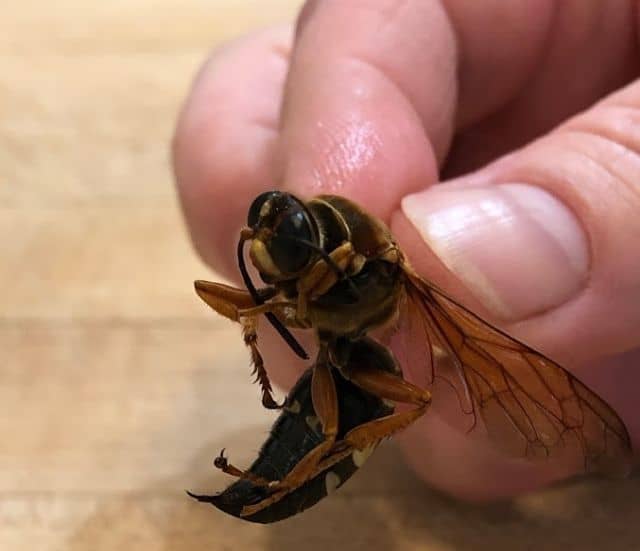
Female cicada killers are larger than the males
The eastern cicada killer wasp is one of the largest wasps seen in the eastern United States. Almost as large as a big paperclip, they are typically anywhere between 1.25–1.5 inches in length. Males are smaller than females. Occasionally, a female cicada killer wasp can be almost 2 inches in length. Other wasps and hornets that compare in size to the cicada killer are the tarantula hawk, European hornet, and the Asian giant hornet, which can grow on average anywhere between 1.5 to as large as 2 inches long.
Where do Cicada Killer wasps Live?

The eastern cicada killer is found in the eastern United States
Cicada killer wasps are solitary wasps, with the female being responsible for building her own burrows and nest chambers, as well as having the sole responsibility to hunt prey to feed her spawn. While they don’t form social colonies like hornets, paper wasps, and yellow jackets, the female cicada killer will tolerate other female cicada killer wasps making burrows in close proximity to her in the same area. Aggregations of multiple cicada killer burrows in a common area are normal.
Aggregations anywhere from a few to, double-digit numbers have been observed in one area. And because burrow sites typically remain appealing to newly emerging cicada killers in the following year, they have the habit of also digging burrows and excavating egg chambers in or near the same location that they emerged from.
Eastern female cicada killer wasps prefer light-textured sandy Florida soil that is damp, but not wet. They prefer warm soil that sits in exposed sunlight, rather than shaded areas. Typically they will choose burrow sites that have deciduous trees nearby with an abundant amount of cicadas to prey on.
Females seek out areas that are sparse of grass rather than those with thick turf and dense roots. They prefer un-mulched, bare soil because it is easier to dig out their burrows.
Their habitats can be found in some of these areas:
- The area between lawns and sidewalks
- Planters
- Underneath concrete
- Ornamental flower beds
- Gardens
- Window boxes
- Under bushes and shrubs without mulch
- Under trees without mulch
- Under tall foliage plants without mulch
- Under patio edges
- Out in the open in the yard
- Sandy areas on playgrounds
- Golf course sand traps and fairways
- Ground covers
Female Cicada Killer Wasps

Only female cicada killer wasps have stingers and males have pseudo-stingers *word this better
Using her jaws and powerful back legs to move out moist sand from the ground, the Central Florida female cicada killer wasp prepares the nesting site. After digging a deep vertical burrow, she digs out several horizontal brood chambers (cells) at the lower end of the burrow, up to 16 cells in total. Each of these cells will become the safe haven for the following year’s cicada killer wasps. After the hole is complete she flies off into the canopy of nearby deciduous trees in search of her prey, the dog-day cicada. Once she finds one, she’ll bring it back to her burrow.
She repeats this process throughout the day from dawn until dusk. She retreats to her burrow after sunset. She’s up again at the crack of dawn to complete her mission of packing each cell with more cicadas.
Once all of her eggs have been deposited, she seals up the birthing cell entrance with dirt. She may or may not close off the entrance to the burrow. She can create up to three more burrows over the next two months.
Males have a short lifespan of two weeks after emerging from the ground. It seems that their only role is that of procreation, which lasts only a brief moment when the summer’s new females first emerge from their burrows. Beyond that, males only spend their time bullishly defending against intruders of their territories to protect mating rights.
The female cicada killer wasp only mates once. The males’ behavior increases their chances that they will be the dominant male that wins the right to mate. Male cicada killers often clash in mid-flight, challenging and wrestling their opponent to the ground, the victor chasing the trespasser out of their territory.
Other insects, humans, and pets can be challenged with face-to-face confrontations by these menacing-looking wasps. This often involves bumping into them to intimidate what they perceive as their competition. They’re so preoccupied with fighting over their territory that they have continuous confrontations.
They battle and challenge each other from morning to evening without rest. In order to cool down from the hot, scorching summer sun, they sometimes vomit on their own heads to produce some evaporative cooling. They do this daily ritual until they die a couple of weeks later.
Cicada Killer Wasp Life Cycle
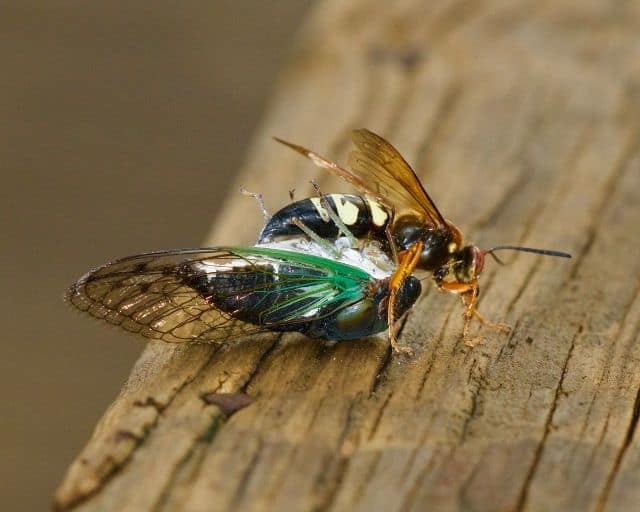
Female cicada killers dig the burrows and provision them with cicadas *Be more clear with this caption
After mating, the eastern female cicada killer digs a tunnel into the soil. From inside this tunnel, she digs out brood chambers (cells). Then she goes in search of food to bring back to the brood chamber to feed her spawn once it hatches. Once she finds her prey, the wasp stings the cicada, delivering venom that permanently paralyzes it, yet keeps it alive. She then carries her large prey to the burrow.
The cicada can be twice her weight. To compensate for this, she drags her prey up the tallest vegetation she can find and propels herself into the air, carrying the cicada as far as she can until she drops to the ground. She repeats this until she eventually gets back to the burrow, where she drags it down into the brood chamber. She then lays a single egg under the cicada’s leg, near the hole of the sting.
During the mating process, she collects sperm from the male in an organ called a spermathecal. Later, as she lays her eggs, she excretes sperm along with the release of an egg through her oviduct. The sex of the embryos within the egg is determined by the female cicada killer.
Fertilized eggs will produce female cicada killers. Unfertilized eggs will produce male cicada killers. For every male egg that the female cicada killer wasp lays, they will only have one cicada in the brood chamber. Female eggs receive two to three cicadas. This allows the female larvae to obtain their larger size. Once the egg is laid and the brood chamber has been filled with the appropriate amount of paralyzed cicadas, the female cicada killer seals off the chamber with dirt and continues with the next chamber.
Cicada killer wasps hatch in two to four days. They enter the puncture wound hole and begin to eat the paralyzed cicadas for about two weeks. Once the larvae finish feeding, only the shell of the cicada will remain. They make a cocoon of silk and sand to prepare for overwintering. In the spring, they’ll enter their pupal stage.
In Central Florida, during mid-June, they emerge from the burrow as adult cicada killer wasps. Males die within a couple of weeks of emerging, while females live approximately two months. By mid-September, female adult cicada killers die off, their larvae left to follow the same cycle the following June.
What do Cicada Killers Eat?

Adult cicada killers only eat nectar and sap *this may be better info for a pullquote since this is just a rewording of what was said below
Like bees, adult cicada killer wasps eat nectar from flowers and plants as a source of energy. Their only other food source is plant sap exudates from trees, bushes, and shrubs. These food sources provide them with high-energy carbohydrates and rich nutrient matter containing amino acids, sugars, and proteins.
Only the newly hatched larvae of the eastern cicada killer wasp will feed off of paralyzed cicadas left in their birth chambers for two weeks. After they create a cocoon, they will eat nothing until they emerge, almost 12 months later. When they do emerge from the burrows the following June, they will be adults and eat only nectar and sap.
What Eats Cicada Killers?
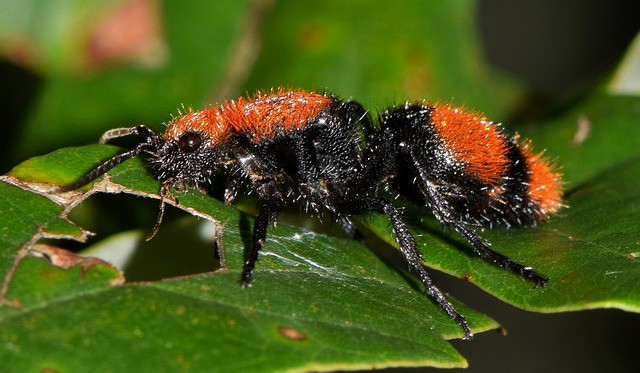
Cow ants sneak into the cicada killer burrow to lay eggs *maybe include a bit more of info
Little is known about what preys on adult eastern cicada killer wasps. Insects, birds, and spiders prey on the occasional wasp. Small mammals might eat the larvae. The cow ant and satellite fly are parasitoid predators of cicada killer larvae.
Cow ants are actually not an ant at all, rather it’s a species of parasitoid wasp. Female cow ants enter a cicada killer burrow to lay their eggs while the female cicada killer is away. When the cow ant’s eggs hatch, her larvae eat the cicada killer’s larva.
The satellite fly follows a female cicada killer back to the burrow and waits for her to leave again. The satellite fly finds a brood cell and deposits a live maggot on the cicada. Sometimes these flies will ghost a female cicada killer bringing back a cicada to the burrow. It then drops a live maggot from its ovipositor onto the cicada from mid-air without the cicada killer wasp knowing.
Once the cicada is placed in the brood chamber, the satellite fly’s maggot will consume the cicada before the cicada killer’s eggs hatch. This leaves the cicada killer larvae without a food source. Without that food source, the cicada killer larvae die.
Cicada Killer Burrow

Cicada killers dig tunnels about 2–4 feet long underground
A burrow dug by a female cicada killer is, on average, about six inches in depth and then continues to run about four feet horizontally. There are also cells (chambers) that she digs out inside of the burrow.
By the time a burrow has been fully excavated, she has moved an impressive amount of damp, sandy soil out of the ground to achieve this. The dirt will be mounded up and kicked away from the u-shaped entrance hole. She may excavate more than 16 individual birth cells deep within the burrow.
Although cicada killer wasps don’t share burrows, during periods of low cicada numbers or in the case of smaller-sized female cicada killers, they will sometimes engage in a form of kleptoparasitism. Kleptoparasitism is the act of theft to steal or eating the prey that another animal has caught. In circumstances where a female cicada killer wasp is unable to obtain her own cicada, she may discreetly enter another female cicada killer’s burrow while the owner is out hunting prey.
The intruder lays her egg on a cicada in an unsealed birthing chamber. She then leaves the burrow, leaving the unsuspecting owner to provision the egg with cicadas. Sometimes the owner of the burrow returns before the intruder has had time to leave the burrow in which they are angrily evicted by the owner.
Are Cicada Killers Dangerous?
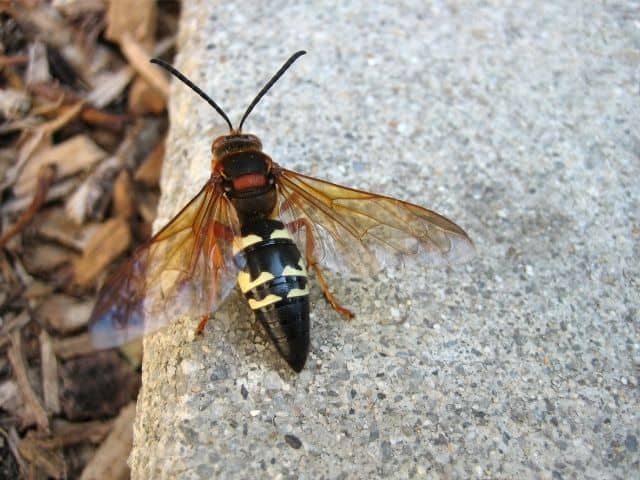
Cicada killers are not dangerous unless you are allergic to wasp venom *this information might be better in a pullquote, since it’s a rewording of what’s already been said
Because of their size and the posturing behavior of the males, people often think that Florida’s cicada killer wasps are harmful or dangerous. Although cicada killers can look intimidating, they really aren’t dangerous unless you have an allergy to insect stings. Cicada killer wasps are sometimes called gentle giants. That’s because the female cicada killer is very docile in comparison to other wasps such as yellow jackets and paper wasps.
The male cicada killer wasp is far more aggressive and confrontational than the female, but he’s harmless. Male cicada killer wasps have a pointed tip at the end of their abdomen that they mimic stinging with stabbing and jabbing motions when they are threatened. It’s all just posturing and he is of no real threat because he lacks a stinger. Males can do little more than bump into you or bounce off of you.
Even though female Florida cicada killer wasps are not dangerous, you should still be cautious and respect their boundaries if you know you have them in your yard. For example, it’s not recommended to be outside barefoot if they’re in your yard. Young children and family pets should be prevented from physically interacting with female cicada killer wasps.
Sometimes a dog or cat will curiously investigate a bit too closely or bite and chase a female cicada killer. This may result in multiple stings on the paw or nose. In the case of biting, a sting to the mouth is the likely consequence. Wasp venom to the mouth has been known to cause severe facial or throat swelling and can require immediate urgent treatment from your veterinarian.
If a female cicada killer lands on you, there is no need to panic, attack, or hurt it, just calmly and gently shoo it away. They’re so busy hunting cicadas and getting them back to their burrows that they don’t have time for people or animals as long as they aren’t being harassed. Of course, it goes without saying that if you have a known allergy to wasp venom then don’t take chances and mess with these guys.
Cicada Killer Sting
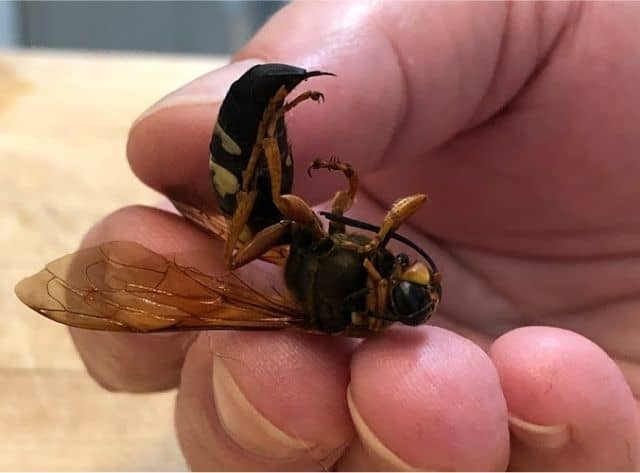
Female cicada killers will only sting if harassed or stepped on
While Florida’s female eastern cicada killer wasp might seem scary and menacing with its significant size and large stinger, they are actually very mild-tempered. They don’t have the social wasp mentality to aggressively protect their burrow nor do they attack in large numbers.
While it’s possible for a female to sting you, they must be excessively provoked, roughly handled, or accidentally stepped on for them to do so. And if you were to be on the receiving end of a female cicada killer sting, according to the Schmidt Sting Pain Index, their sting is less painful than the sting of a honeybee.
Cicada Killer Sting Wound
So, what happens if you do get stung by a cicada killer? The sting will likely react like any other type of wasp sting as long as you don’t have an allergy to insect stings. If you have a known allergy, get immediate medical attention.
If you are not allergic, you’ll typically experience pain and swelling around the area where you were stung. The center of the sting will be a raised white mark where the stinger entered your skin. The sting will probably feel hot and perhaps itchy with about 10 minutes of mild to moderate discomfort.
If you’re stung by a cicada killer, you should first wash the sting site if possible. Doing so helps remove some of the venom. Here is a list of home remedies that you could also try to take away the discomfort:
- Antihistamines such as Benadryl, to relieve the histamine reaction of itching and swelling
- Pain reliever such as acetaminophen or ibuprofen to reduce pain and swelling
- Vinegar applied on the sting site with a cotton ball to neutralize the venom
- Lemon juice dabbed on the sting site with a cotton ball to help treat the pain
- Apply ice to the sting site to soothe swelling and pain
- Hydrocortisone cream to help relieve irritation and itching surrounding the sting site
- Toothpaste to help with itching of the sting site
- Garlic or onion applied to the sting site may help with pain
- Baking soda/water mixture applied as a paste to the sting to ease pain
- Oatmeal soak to help soothe itching, swelling, and pain
- Meat tenderizer/water mixture applied as a paste to the sting breaks down venom
- Aloe vera gel to help relieve the histamine reaction of the sting site
Are Cicada Killers Beneficial

Cicada killer wasps help control annual cicada populations
Florida cicada killer wasps are considered beneficial since they help control the annual cicada populations. Their larvae provide food to the satellite fly and the cow ant, boosting their species population.
Another important benefit of adult cicada killer wasps is that they make a small contribution to pollination. Although not as proficient at pollinating as bees are, they do pollinate while they visit flowers and plants to drink nectar between digging holes and hunting prey.
While it may seem like cicada killer wasps don’t benefit much, keep in mind they also equally don’t harm much. The worst that cicada killers do is create burrows. Yes, their burrows are unsightly and messy, but because of their short two-month existence above ground, the damage is typically superficial and limited.
Cicada Killer Wasp Lawn Damage
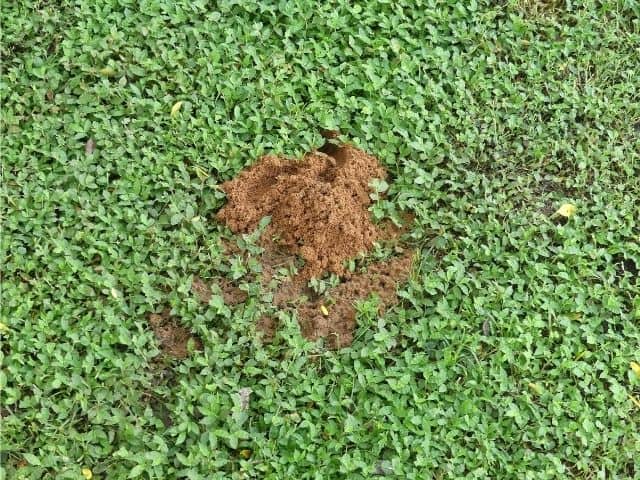
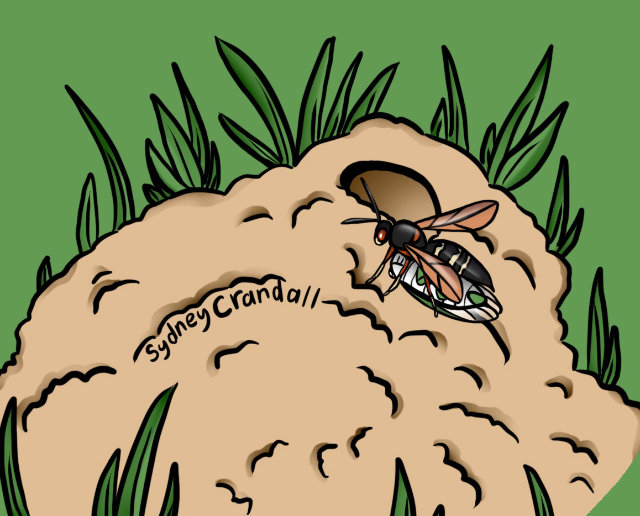
Multiple cicada killers can make unattractive burrows on your lawn
Although it can be unsightly, typically there are no measures that need to be taken other than just to sit it out and wait if it’s only a handful of cicada killers in your yard. Florida cicada killer wasps typically only do minor damage to yards, vegetable gardens, and flower gardens, or maybe dig under a patio brick or paver. This is usually only superficial damage and can easily be repaired after the end of two months after their lifecycle has been completed.
Despite that, there are still going to be people who are not happy with the holes and piles of sand that cover their yard. Or, they have children or pets that could be in danger of accidentally stepping on one of the female cicada killer wasps. Or, in the case of pets, where they’re nosing around burrow site.
Some people don’t like having to work around them in their plant and vegetable gardens and dislike the damage they can do to new transplants or plants that have a delicate root system. Sometimes, it might be as simple as they themselves don’t like them and feel threatened or scared of the giant-sized wasp.
Cicada killer wasps aren’t just limited to lawns. They also can make their burrows on golf courses and in public playgrounds. These are places where they could become a nuisance because someone could easily step on one and get stung. In these instances, you might consider eliminating them. In the next section, we’ll give you some tips on just how to eradicate them from your yard.
How to Get Rid of Cicada Killers
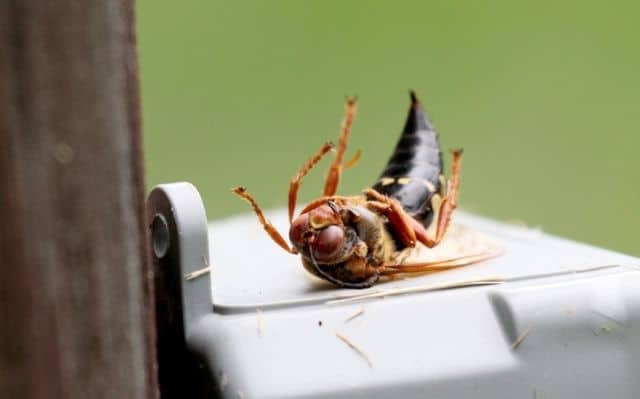
If you can’t tolerate cicada killers, there are ways to manage them
If you really feel the need to eliminate Florida’s cicada killer wasps from your yard you have a few choices. If you have only a few cicada killer wasps in your yard you should be able to easily eliminate them yourself by using an environmentally friendly and natural method. However, if you have a large aggregate of them you may need to use pesticides or you may wish to call upon a professional exterminator.
Removing cicada killers and destroying the eggs and larvae as well as their food source is the first step. Secondly, take steps to minimize their return in the future. You can attempt these methods for killing a female cicada killer, her eggs, or larvae inside the burrow.
1) Cicada Killer Wasp Removal: Boiling Water Method
A free, natural, and environmentally friendly method to eliminate Florida cicada killer wasps in your yard is boiling water. Take a pot of boiling water and slowly pour it into the burrow hole. This will kill the cicada killer wasp and the paralyzed cicadas if done at night when the female cicada killer has returned to her burrow for rest.
2) Cicada Killer Wasp Removal: Boric Acid Method
Another economical method is a good dusting of boric acid powder puffed down the tunnel. This is also considered environmentally friendly. Again, doing this at night ensures that the adult cicada killer will be in the tunnel. In just a few days, your cicada killer population should decrease.
Once you have eliminated the cicada killers from your yard, you’ll want to make some of these improvements to make your yard less desirable for them:
- Set your lawnmower at the highest setting
- Properly maintain your yard with water and fertilizer to grow thick turf
- Use mulch under shrubbery
- Keep the soil damp
- Cover any new holes with geotextile or mulch to discourage further digging
3) Cicada Killer Wasp Removal: DIY Pesticide Method
Pesticides such as hornet spray, pyrethrin powder, sevin dust, or liquid concentrate cypermethrin can be used if the natural methods haven’t worked or if you have too many cicada killers in your yard. Follow the instructions on the particular pesticide you decide to use. This method is for those who prefer a DIY approach.
4) Cicada Killer Wasp Removal: Professional Services Method
Lawn and pest control services are the most expensive option. They typically will use powerful and sometimes faster-acting pesticides. While some companies will offer services with multifaceted approaches, including filling and closure of the burrows, others do not. Many offer yearly yard pest maintenance control packages, however, without eliminating the eggs, the cicada killer wasps will likely emerge in your yard again the following year.
Other Cicada Killer Wasp Resources
The following two videos provide additional insight into the eastern cicada killer wasp. The first, “Ryan the Bugman”, provides an uncommon opportunity to see the architecture of the inside of a cicada killer wasp’s burrow, including a glimpse of the cocooned larvae.
The next video is a nature clip that shows the very exhausting process that the female cicada killer wasp goes through to get a cicada back to her burrow.
Cicada Killer Wasp Summary
*Change this summary title and add photo
We hope this article has convinced you that you don’t have murder hornets invading your backyard. We also hope that you walk away with a new appreciation, or at the least a better perspective on these gentle giants known as Florida cicada killer wasps. For the most part, they are largely harmless and beneficial, playing an important role in our ecosystem. What’s your take on Florida’s cicada killers? Friend or foe? Tell us in the comments.