


*Note—add a topic talking about the lack of lovebugs in the past two or so years
Florida has a few seasons—the wet season, the dry season, hurricane season, and tornado season, but there’s one season in particular that many dread each year. Natives and tourists alike agree that the Florida love bug season is bothersome for many reasons.
Florida love bug season begins like clockwork in Central Florida during the months of May and September. During those two months plecia nearctica –– lovebugs, plague Floridians and tourists alike in epic proportions for four weeks each time. It’s impossible to escape them. Read on for more interesting facts about lovebugs.
Developing love bug larvae (maggots) emerge from the ground after maturing and they set off to reproduce. Mating pairs and singletons float lazily in the air, being directed whichever way the wind blows them. Swarms of these little black flies can reach hundreds of thousands in number.
Lovebugs are arthropods and have also been referred to as honeymoon flies, telephone bugs, and double-headed bugs. They are identifiable by their distinct black bodies with black velvety wings and vibrant orange-red thoraxes.
Scientifically speaking, they’re not a bug. They’re a type of fly related to the Bibionidae family. The Bibionidae family is in the same family as march flies and is closely related to mosquitoes, sandflies, and gnats. Male lovebugs are smaller than females. Females are bigger and weigh more. Male lovebugs can also be distinguished by the size of their noticeably larger eyes.
The gray larvae hatch in 2-4 days from the eggs that the female lays on decaying vegetation. They live in groups in the decaying vegetation as well as on the ground beneath organic matter. Here is where they’ll remain for 120 days in the summer or 240 days in the winter. Once the maggot reaches the pupa stage, it emerges as an adult 7-9 days later, and the cycle repeats.
Where did Florida Love Bugs Come From (Myth Buster)
There are some myths that never seem to die about how Florida love bug season was started. To this day these myths are still circulating. It has been rumored for decades that the University of Florida (UF) in Gainesville was to blame. Some of the following are claims that have been made:
- Lovebugs were genetically engineered “designer” insects created by entomologists at UF to kill mosquitoes.
- A science experiment went awry when UF created a sterile female species that would mate with male mosquitoes and bore no offspring, and instead ended up creating larvae known as lovebugs.
- Lovebugs escaped after UF scientists brought them to Florida.
The University of Florida has always debunked all of these theories as untrue, stating that lovebugs are not equipped with speed, strength, or the mandibles (jaws) to kill mosquitoes. So, lovebugs are just that, lovers not fighters. As herbivorous insects, they only feed on pollen and nectar.
UF scientists started studying Florida love bugs well after they were established in Florida. While it’s true that lovebugs aren’t native species to the southern United States, the truth in how it got here in Florida probably isn’t quite as exciting or diabolical as all of the myths.
It’s thought that this invasive species, which came shortly after WWII, hitchhiked from the Yucatan in Mexico to Texas via ship. In the 1920s the first recorded lovebug swarm was in Galveston, TX. They continued to migrate through the states bordering the Gulf of Mexico—Louisiana, Mississippi, and Alabama.
By 1949, Florida was the last Southern Gulf Coast state that the lovebugs inhabited. But, they didn’t stop there. By the 1970s they were still on the move and had their sights set on the Southern East Coast. Lovebugs now call Georgia, South Carolina, and as far north as Wilmington, North Carolina, home.
Two Headed Bug – Spoiler Alert
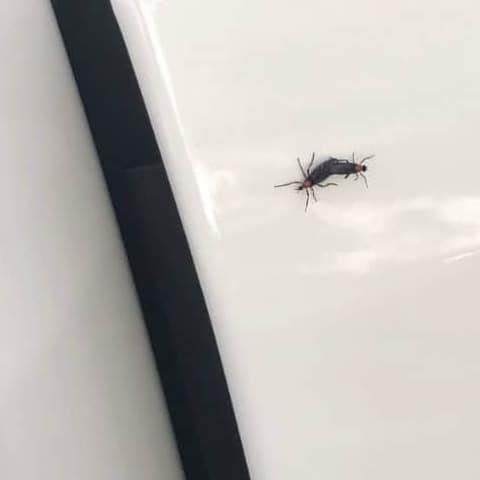
Mating pair of lovebugs coupled together
If you see a lovebug and it looks like it has a head on each end of it, look closer and you’ll see it isn’t a singular bug. It’s actually two. They are a mating pair coupled together. The male is the smaller of the two and he’s also the one being dragged around backward.
Not all love bugs will be paired. It’s quite normal to see single lovebugs flying around, living life independently. This could be a lovebug that hasn’t found a mate, or perhaps it could be a lovebug that’s been separated from its mate.
The female lovebug’s emergence from the ground is preceded about an hour earlier by smaller male lovebugs. Males hover around the ground waiting for the females to emerge. Male competition over females is strong. As the female crawls up vegetation and attempts to fly up into the hovering swarm, male lovebugs will grab onto her mid-flight and bring her back down to the ground. The winning male will join her to start reproduction.
Even this is no guarantee, as other males, especially larger ones, attempt to knock the winning lovebug off his selected mate to try and steal her away. However, if he can stay attached to her long enough, they’ll begin the process of copulation.
At first, the male is positioned on her back and they both face the same direction. After pairing is complete, the male turns 180 degrees and they face opposite directions of each other. This gives the appearance of having a head at both ends.
They spend their time flying in tandem. The larger female leads the navigation and the smaller male has no choice but to follow the direction that she chooses. Usually, the male stays coupled and copulates with the female until he dies a few days later.
How Long is Lovebug Season in Florida
In Central Florida, the first lovebug season starts in late April and runs through early May—the second season begins in late August and runs through early September. In southern areas of the state, there can be a short third season in December. The second season typically has fewer lovebugs.
It’s thought that the Florida love bug season ends because most of the adult lovebugs have died off, and until the next season, the larvae are maturing. Lovebugs are thought to be especially plentiful in some years more than they are in others depending on the rain.
The larvae struggle through drought—so the years that provide a lot of rainfall after long spells of drought and mild winter helps them thrive. During these years, it’s been observed that once the lovebug season starts again, the number of lovebugs is greater than usual.
The good news—you only have to tolerate them for a few weeks, twice a year. They don’t invade your trash as flies do. They don’t bite or sting. They aren’t poisonous or spread disease like other pests do such as the kissing bug, tick, and mosquito.
The bad news—you have to tolerate them for a few weeks a couple of times a year, and, while lovebugs are harmless, they’re not something that most people love. They create grief for motorists. They become annoying, uninvited guests to your pool parties, cookouts, and picnics—crawling on your food and beverages. They crawl all over buildings, fences, windows, shrubs, pretty much everything.
They swarm your face, land in your hair, and on your clothes, crawling on anything in their path. Cyclists and joggers are at their mercy. They can get inside your garage and home, particularly liking dark, humid rooms with a lot of moisture.
Lovebug Swarm Hell
Lovebugs cause folks in Central Florida as well as the rest of the state a lot of grief twice a year, but 5 decades ago the lovebug population was out of control. The Sunshine State had been invaded by this invasive species during the 1940s. At first, they weren’t so bad, but by the early 1970s, the Florida love bug population increased significantly.
Maybe because farmers changed how they pastured their cows or because the state had increased grass mowing alongside the highways—something created the perfect conditions for the lovebugs to thrive so heartily. So thick were the swarms of lovebugs on the highways that they would clog driver’s radiators, causing vehicles to overheat.
Massive swarms of lovebugs were so thick on the interstate that they would cover windshields, obscuring driver’s visibility. This made for hazardous and unsafe driving conditions, making it necessary for drivers to frequently pull off the highway to clean the opaque smears from their windshields.
In 1971 a bill was rejected that would have authorized the state $25K to stop the lovebug invasion. Quickly, legislators realized that this was a mistake. In 1972, during Florida love bug season, some gas stations charged an extra fee of 75 cents to remove the lovebugs from your car if you didn’t purchase a minimum of 10 gallons of gasoline.
Gas stations weren’t the only ones to take advantage of the lovebug crisis. Car washes drew in good business. Children on the side of the highway offered roadside lovebug cleaning services. These young entrepreneurs would charge $1.00 per vehicle.
Insecticides didn’t reduce their numbers and by 1972 Florida had enough. Florida’s governor at the time devoted $75,000 to research lovebugs. By the end of the 1970s, their population had dwindled enough to not be considered dangerous anymore.
Even now researchers still don’t understand what caused the drop in their numbers. They have been reduced from hazard to nuisance and thankfully their numbers continue to remain manageable today.
Are Love bugs Harmful
You might think that just because lovebugs don’t bite, sting, or spread disease, they’re nothing more than a nuisance. They actually can cause harm and damage in other ways. During this biannual season, lovebugs come out en masse. Sometimes individual lovebug swarms can be so thick that they can become a serious traffic hazard to motorists driving through them.
Vehicles driving through these thick masses can quickly find their windshields splattered with the bodies of hundreds of dead lovebugs. With so many mating pairs hitting the windshield at one time it sounds like sleet. Trying to clear the window with the windshield wipers can make it all the worse as they create a greasy, white smear and obscure driver visibility even further.
This greasy white smear is actually lovebug eggs. And, the windshield isn’t the only place that these masses hit. The entire front end of the vehicle has now become a magnet for these little menaces. They cover the headlights, the radiator, and the hood with their bodies and gooey splatters, which not only look gross but can have negative effects on the vehicle as well.
In serious cases, they can clog the radiator fins over time and cause overheating, as well as damage trucks if they get into the refrigeration equipment. They can diminish the range of your headlights, but probably the biggest effect is on your car’s paint job.
When the sun bakes the dead lovebug bodies, they start to become acidic. If dead lovebug bodies are not removed from the vehicle’s paint in a timely manner they will start to dissolve the paint finish in as little as 24 hours. Eventually, if left on long enough, they will start pitting the surface of the paint, causing permanent damage.
What Time of Day do Love Bugs Come Out
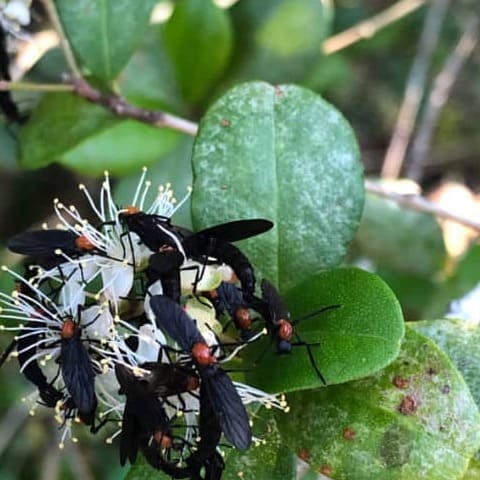
Lovebugs are active from mid-morning to sunset
Lovebugs prefer sunny days and warm temperatures of 84F (28C) or hotter. They start their day by moving up from low-growing vegetation onto plants to feed on nectar. Once the temperature gets above 68F (20C) and the mid-morning sun is up, coupled pairs disperse into the air.
Males that have not yet mated hover in swarms over the emergence sites where they wait to grab females as they emerge from the ground. Starting from mid-morning through the evening, the conjoined pairs continue their in-flight mating. Copulations take place over 2–4 days on average before the female lovebug detaches from her mate to lay her eggs.
As lovebugs disperse into the air to look for food and water, they are attracted to shiny surfaces, freshly painted surfaces that are light-colored, lighter-colored surfaces in general, blacktop roads, and hot car engines. They are also attracted to the UV irradiated aldehydes that come from both diesel and gasoline combustion fuels such as exhaust fumes from vehicles and lawnmowers.
There is some speculation that lovebugs confuse the smell of carbon monoxide coming from the exhaust fumes for that of carbon dioxide—which comes from decaying plant matter where the female lovebug seeks to lay her eggs. It makes sense that one might experience clusters of them accumulating around cars, streets, roads, and highways right in the middle of most people’s daily commute or during their outside yard work.
Around 6:00 PM, or just before sunset, they settle back down on low-growing vegetation to conserve their energy overnight so they are ready to start the next few days in the same way.
Love Bug Purpose
More often than not, lovebugs are considered an annoying nuisance. However, environmentally speaking, it seems they play a vital part in their ecosystems serving, a couple of positive purposes other than just making a mess on the front of your car and windshield.
According to the UF, Institute of Food and Agricultural Sciences (IFAS), immature lovebugs are beneficial for the environment because part of the larvae’s diet includes dying vegetation. As the larvae eat this organic material, it aids in recycling and redistributing essential nutrients back into the ground. This helps to support plant growth.
Although some beekeepers complain that their worker bees won’t visit flowers that have lovebug infestations, adult lovebugs are also important since they too help pollinate. Though they are not as heavy pollinators as our ecosystem hero, the hard-working honey bee, or even butterflies, they still offer a small contribution.
They feed mainly on nectar and pollen from flowers. While feeding, they collect pollen on their bodies, which they then spread to the next flower or plant. This helps to fertilize the plants while they are feeding.
What Love Bugs Eat
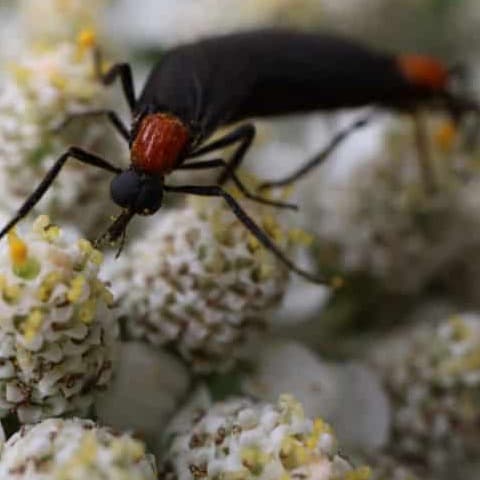
Love bugs eating pollen from a flower
A mature lovebug’s diet consists solely of nectar and pollen from a number of plants. They consume nectar from goldenrod, Brazilian pepper, and sweet clover plants among a few others.
It’s been noted that the larvae and pupae of lovebugs can withstand many weather conditions as they continue to feed off of dying vegetation. Long spells of drought, however, can prove difficult for larvae.
The reason larvae struggle through this is because dry weather shortens their main source of organic matter, which is thatch. Thatch not only provides them food but also shelter.
Larvae can only survive for 24 hours without eating. Pupae, on the other hand, can tolerate and live through long spells of drought. In 2021, the Florida love bug population was smaller. This was thought to be due to diminished rainfall for that year.
What Eats Love Bugs
Adult lovebugs have no real known animal or insect predators. The lovebug’s larvae have the most predators, but even that is scarce. The mortality rate for lovebugs, mature and immature, is very low.
Dragonflies, a few foraging birds such as quails and robins, hunting spiders, lizards, praying mantises, centipedes, earwigs, and a couple of beetle larvae make up the list of predators that feed on immature lovebugs. Although, it’s probably not deliberate and more of accidental consumption.
It’s thought that the reason lovebugs have such few predators is because of that acidic chemical they have. It’s speculated that the acid has an awful taste to it, which would explain why many insectivores don’t eat lovebugs.
There is, however, a natural enemy that does affect them. Beauveria bassiana is a natural growing fungus that is found in soil throughout the world. This particular fungus acts as a type of parasite on the arthropod. This fungus kills up to 33% of adult and immature lovebugs.
There are several other fungi that affect only immature lovebugs. Unfortunately, like other lovebug predators, fungal pathogens don’t contribute enough to the death of lovebugs to keep them well balanced because the lovebug population is so plentiful.
Love Bug Eggs
Methane and carbon dioxide gas are naturally occurring organic compounds that are produced by decaying organic matter such as decaying leaves or dying plants. These gasses attract female lovebugs who seek suitable areas to lay their eggs. Preferring areas that are consistently moist under the rotting vegetation is where the female looks to lay her eggs.
This includes moist sandy areas, along roadsides, in pastures under cow manure, and in wooded ravines. They can also be found in grassy habitats, such as Bahia grasses, along grassy creek banks, under dead leaves and grass clippings, and in any location that has decomposing organic debris.
Your yard can be attractive to the female lovebug too. Perfect egg-laying sights are landscaping that provides moist leaf litter, grass clippings, compost piles, or even damp areas. Larvae will thrive in this environment. This is important because lovebugs spend most of their lives as larvae and organic compounds are all the larvae eat.
Depending on the time of year, Florida love bug larvae depend on these organic compounds to sustain them for 120–240 days. The female chooses a site that will support that need.
After she has selected her spot, she lays her small gray eggs in or on top of the soil under this debris. After about 20 days, the larvae hatch. They live close to the surface and the debris provides both food and shelter for them.
How Long do Lovebugs Live
In nature, the average pair of lovebugs live 3–4 days, mating for two to three of those days. They live just long enough to mate, reproduce, feed, and lay eggs.
While males and females are connected, the male shares nutrients from his body with the female. This ensures healthy egg development for the female. Many times, even after the male dies, the female will fly around with his dead body still attached to her.
Eventually, she will disengage from him and lay her eggs on partially decayed plant matter or animal dung on the soil. She can lay between 150–600 eggs, but on average she lays about 350 eggs. Living only a short time longer than her mate, after laying her eggs the female lovebug has helped to preserve her species. Her lifespan has come to an end and she dies.
After her eggs hatch in 2–4 days, the larvae will live and eat the organic material in the soil around them, such as decaying plants. For many months, they will mature into pupae beneath the ground. The mature pupae emerge from the ground about a week later as adult lovebugs with one goal in their short adult lives—the natural instinctive drive to procreate.
Cleaning Love Bugs off Car Hacks
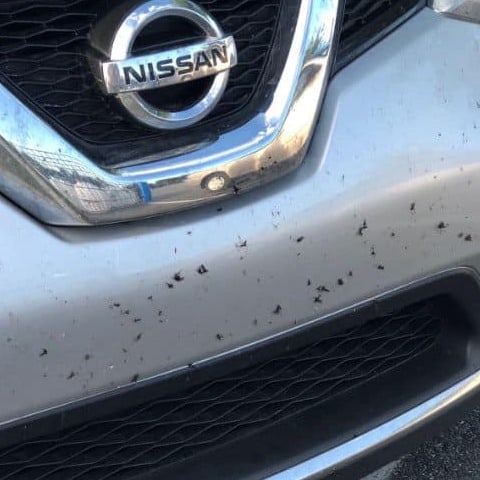
A typical sight in Central Florida during lovebug season
There is no real way to avoid inevitable lovebug splatter on your vehicle’s grille, hood, headlights, and windshield in Central Florida, short of not driving in the months of May and September. This isn’t going to be feasible for most people.
If you don’t remove the lovebug remnants from your vehicle on a regular basis, they become difficult to remove and can damage your car’s paint job. This usually means you have to do more frequent car washes.
Many car wash facilities have bug removal pre-sprays that are sprayed on your vehicle’s bumper and headlights just before you go through the carwash. Some facilities offer car detailing services and will remove all those ugly lovebug remnants.
But, what if you want to manage these greasy baked-on dead critters yourself? One look on google and you will immediately see a plethora of advice from people on how to remove love bugs off vehicles.
Here are some of the more popular hacks for how to remove or minimize love bugs on your vehicle that Central Floridians swear by:
- Waxing your vehicle with a quality wax just prior to Florida love bug season starts to help prevent them from sticking so easily.
- Using windshield sealants will create a slick surface allowing for easier removal.
- Spray your vehicle with water and thoroughly wet a new dryer sheet. Gently rub it over the dried-on lovebug remnants and rinse well.
- Clay lubricant and detailing clay—spray the lubricant on the lovebug remnants and rub with the detailing clay to remove them.
- Bug deflector shields, protective bug screens, and car bras for the front of your vehicle to help keep lovebugs from coating the grill and clogging your radiator. (Be aware that they require some specific care to protect the vehicle’s paint finish underneath them)
- WD-40—spray on affected areas and leave it for about 10 minutes. The penetrating oil helps loosen the dead lovebugs. Wipe off and repeat if necessary.
- Citrus-based degreaser—it helps break down organic compounds, making it easier to remove dead lovebugs.
- Add some baby shampoo to your bucket of soap when you wash your car.
- Commercial products are readily available. When applied with some elbow grease, they can assist in the removal of dead lovebugs.
Some of the suggested lovebug removal techniques included cooking spray, Mr. Clean Magic Eraser, Avon’s Skin So Soft, and Murphy’s Oil Soap. However, many warn against this advice, citing that undesirable results such as damage to paint or clear coat could occur. You should always check with a knowledgeable person before using something on your vehicle’s paint finish if you are unsure if it could be damaging.
How to Get Rid of Lovebugs
In the late 60s and early 70s, lovebugs were a lot more prolific in Central Florida than they are today. With such a large lovebug population, it resulted in unsafe and sometimes hazardous daytime driving conditions for motorists.
In an attempt to reduce the number of lovebugs on the highway, the Florida Department of Agriculture did an aerial spray. Using a helicopter, they sprayed insecticide over the highway. Unfortunately, the decline from the swarming masses was short-lived and the lovebugs quickly returned.
While there are insecticides that will kill some adult lovebugs, they will not kill all of them. Broad spraying of chemical controlling insecticides is generally not very effective. Lovebugs are so numerous that in a short amount of time, they will be replaced by more lovebugs flying in from surrounding areas.
Lovebugs can also easily fly up onto the breeze to avoid these chemicals. Pesticides aren’t going to be effective enough to cut through the massive lovebug population that is so large. Entomologists recommend that you don’t use pesticides and many pest control companies won’t treat lovebug infestations.
Using chemicals to try and rid yourself of them is costly, a waste, and risky because they can be harmful to sensitive people as well as animals. Insecticides can also have negative environmental repercussions by impacting nontargeted insects, such as ladybugs, honeybees, and other beneficial pollinators.
There really isn’t any permanent way to control them. The best thing you can do is wait out their mating seasons, but if you’re really starting to get bugged by lovebugs, there are a few preventative and protective measures that might help to minimize their effects on your environment.
How Do You Keep Love Bugs Away – Tricks
Just as there are many suggested hacks online for how to remove lovebug remnants from your vehicle, there are also several suggestions on how to best manage lovebugs that invade your personal space—namely inside your home and on your patio.
Some people swear by some of these suggestions while others have had mixed results or no results at all:
- Box Fans—running a box fan and attaching some mesh netting to the side of the fan that the air blows out will catch lovebugs that get sucked through the fan.
- Ceiling Fans—lovebugs aren’t strong flyers. Currents of air from fans may help keep them from being able to enter your home.
- Vacuum Cleaner—suck up lovebugs in the vacuum cleaner.
- Electric fly swatter—zap lovebugs that are flying inside your home and ones pestering you outside on your patio.
- Swiftness—this may seem obvious, but enter and exit your home, shutting the door quickly to try and minimize how many gain access to inside.
- Window Screens—make sure that any windows that you have open, especially on the windward side of your home, have window screens in them.
- Citronella Candles or tiki torches filled with citronella oil—light when outside on your patio.
- Outdoor Ceiling Fans—the downward draft from the ceiling fan makes it difficult for lovebugs to float in the air.
- Love Bug Trap—fill a white container half full with water and mix in some liquid dish soap. Place the container near your door. Lovebugs will crawl into the water and die. Empty as necessary.
- Yard Maintenance—maintain your yard by cleaning up dead plant debris, leaf litter, and by keeping your yard mowed to cut down on leaf litter and thick thatch to make it less attractive to lovebugs.
*Include in the summary—use this info in the closing
Central Florida Weather’s Takeaway
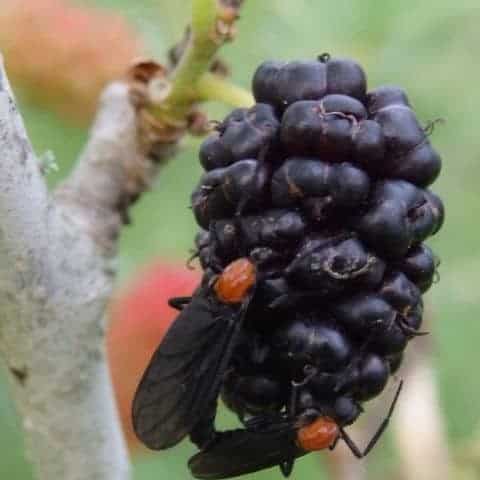
Lovebugs resting on mulberries
You might as well learn to cope with these little black and orange flies. Like it or not, the Florida love bug is here to stay. Yes, they are annoying and messy, but they don’t sting or bite and they don’t harbor disease. Thankfully they are only here in Central Florida for a few weeks, a couple of times a year.
If this is your first time experiencing lovebugs, we hope we’ve helped you learn something about them. What do you think? Love them, hate them, or tolerate them?
Feature Image by Sydney Crandall/ Central Florida Weather